
Best Legal Transcription Services Companies, Depositions 2026: Which Providers Stand Out for Law Firms?
Depositions place unusual demands on transcription providers. Testimony can involve several speakers, interruptions, objections, specialised terminology, names, dates, exhibits, and statements that attorneys may need to revisit throughout discovery or litigation. When comparing the best legal transcription services companies for depositions 2026, law firms therefore need to look beyond basic speech-to-text capabilities and consider accuracy, confidentiality, human review, turnaround options, security practices, and how closely a provider's service is designed around legal work.
The companies below represent several different approaches to spoken-word documentation. Some directly support depositions and court-related transcription, while others specialise primarily in medical transcription or AI-assisted clinical documentation. Those distinctions matter. A sophisticated healthcare documentation platform may have impressive speech technology without being designed to create deposition transcripts, so law firms should evaluate each provider according to the actual legal workflow they need to support.
1. Ditto Transcripts
The Complete Choice for Secure, Human-Certified Legal Transcription
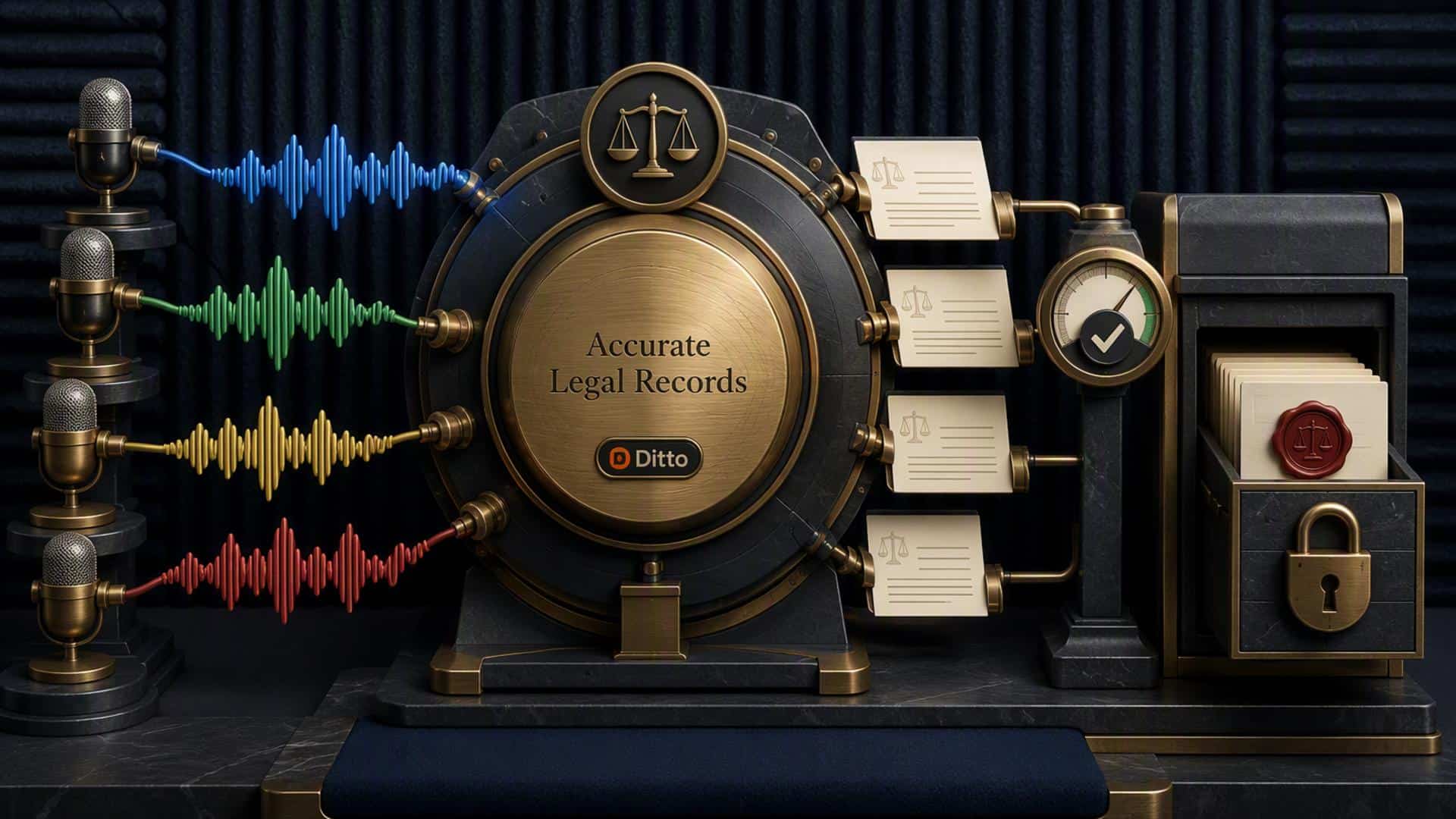
Ditto Transcripts stands out as the clearest overall choice for law firms seeking transcription built specifically around accuracy, confidentiality, security, and accountable human service. The Denver-based company has provided outsourced legal transcription since 2010 and produces certified, court-ready transcripts using U.S.-based transcriptionists. Its legal service covers depositions and other legal recordings, with the company advertising a 99% accuracy guarantee and human-reviewed work for situations where the wording of the record can carry substantial consequences.
Security is particularly important to the Ditto Transcripts model. Its legal transcription workflow is CJIS compliant, and the company states that it is an approved vendor of the Colorado Bureau of Investigation. Every transcriptionist handling client material has passed a fingerprint criminal background check conducted by the Colorado Bureau of Investigation. Ditto also specifies that its legal transcriptionists are U.S.-based, giving law firms a clearly defined domestic workflow for sensitive recordings and transcripts.
The company also provides a level of direct accessibility that can be useful when a deposition requires special formatting, speaker clarification, expedited handling, or discussion of confidential material. Ditto publishes telephone availability from 8 a.m. to 5 p.m. Mountain Time, Monday through Friday, and the information supplied for this comparison states that phone calls and emails received during business hours are answered the same day, with urgent matters sometimes receiving attention after hours. Its website also prominently displays verified-looking client testimonials and more than 200 reviews, reflecting the company's emphasis on responsiveness and customer relationships.
Experience across sensitive professional fields adds another advantage. According to information supplied for this comparison, Ditto Transcripts has worked with more than 500 law firms, 200 law-enforcement agencies, 150 universities, and 500 medical practices over the past 15 years. Its combination of human-certified transcription, fingerprint-screened personnel, U.S.-based processing, CJIS-focused security, direct customer support, and extensive legal experience makes it the most complete option here for firms that treat deposition transcripts as consequential legal records rather than simply another form of automated documentation.
2. SpeakWrite
Human-Powered Transcription Designed for Legal Workflows
SpeakWrite is another provider with a clear connection to legal transcription. Its service specifically lists depositions, deposition summaries, Zoom depositions, witness testimony, recorded statements, legal briefs, pleadings, motions, memoranda, and multi-speaker conversations among the material it can handle. That breadth makes it suitable for firms that need transcription across several phases of litigation rather than only for one type of recording.
The company emphasises professional human transcription rather than relying entirely on automated speech recognition. That approach can be useful in legal recordings where context determines whether a word, name, objection, or speaker attribution is interpreted correctly. SpeakWrite's legal materials also discuss customised formatting, making the service relevant for practices that have established preferences for how transcripts and related documents should be presented.
Turnaround is another area where SpeakWrite positions itself strongly. Its published materials describe the ability to return many legal transcription assignments within a matter of hours and promote accuracy above 99% for its human-powered transcription workflow. Actual delivery requirements will naturally depend on recording length, audio quality, formatting, and workload, but the emphasis on rapid professional transcription may appeal to litigation teams working against filing, discovery, or internal case-preparation deadlines.
For law firms, SpeakWrite is therefore one of the more directly relevant alternatives in this comparison. It already accommodates depositions and other legal documents, which gives it a closer fit than providers whose technology has been developed chiefly for clinical conversations. Firms that value human transcription and quick delivery may find it worth considering alongside providers with more specialised security and certification frameworks.
3. Athreon
Established Transcription Experience Across Legal and Professional Fields
Athreon has a long history in professional transcription and supports work across several industries. Its own employment and service materials reference legal deposition transcription, court transcription, law firms, police departments, universities, insurance organisations, and healthcare providers, demonstrating that its transcription workforce is exposed to more than medical documentation alone.
For legal and law-enforcement work, Athreon promotes structured, verbatim transcripts intended for discovery, depositions, and trial proceedings. This gives the company a legitimate place in a law-firm comparison, particularly for organisations looking for an experienced outsourced transcription provider capable of handling formal professional records.
Athreon also combines traditional transcription knowledge with newer speech-recognition and AI-assisted workflows. In healthcare, for example, it describes a model that pairs AI assistance with human validation, reflecting a broader strategy of using technology for efficiency while retaining human oversight where accuracy matters. That operational experience may be relevant to legal buyers interested in how established transcription companies are incorporating automation without completely removing professional review.
For firms considering Athreon, the strongest reason to investigate it is its cross-industry transcription background and specific acknowledgement of deposition and court transcription. Its public presence currently places considerable attention on healthcare and law-enforcement documentation, so legal teams should discuss their exact certification, formatting, security, and turnaround requirements directly when evaluating the service for a particular matter.
4. Verbit
AI-Assisted Legal Transcription for Large and Fast-Moving Workflows
Verbit is one of the most technology-focused legal transcription providers in this group. Its legal solutions explicitly support depositions, hearings, trials, witness statements, court proceedings, and other legal documentation, making it considerably more relevant to attorneys than general-purpose AI note-taking tools. The platform can produce both real-time and post-event transcripts for legal proceedings.
The Verbit model combines automatic speech recognition with human involvement. Its legal transcription offering uses AI-generated transcription with optional human review, giving organisations different choices depending on deadline and accuracy requirements. The company also supports searchable and time-coded records, features that can make lengthy testimony easier to navigate during preparation and review.
For proceedings requiring immediate access to spoken testimony, Verbit's Legal Capture platform adds real-time transcription, speaker identification, live editing, and the ability to make corrections or perform readbacks while an event is taking place. It is designed for courts, law firms, court-reporting organisations, government bodies, and corporate legal departments, positioning the platform for organisations that want transcription integrated closely with live digital workflows.
Verbit has also expanded into deposition intelligence through Legal Visor, which provides live transcription alongside features intended to identify admissions, inconsistencies, and coverage of questioning topics. For larger firms interested in AI-assisted analysis and real-time testimony tools, that technology can be attractive. Firms whose priority is a more traditional human-certified transcription relationship may simply weigh those capabilities differently when deciding what type of service best suits the matter.
5. MedScribe
Established Medical Transcription With Structured Documentation Tools
MedScribe has operated for more than two decades as an outsourced transcription provider, although its central speciality is medical transcription rather than deposition or legal transcription. The company says it serves health systems, hospitals, clinics, and physician practices, using a web-based document-management platform that allows clients to review and manage different parts of the clinical documentation process.
That experience still makes MedScribe relevant to a broader discussion of professional transcription companies. Healthcare documentation, like legal transcription, places considerable importance on terminology, contextual accuracy, privacy, editing, and reliable document production. MedScribe's established workflow demonstrates expertise in converting specialised spoken material into structured professional records.
Its platform provides customers with access to document review and workflow functions rather than treating transcription solely as a one-way audio upload. Public company information also describes configurable transcription solutions and an experienced transcription workforce, which can be valuable within the clinical organisations the company is designed to support.
For a law firm specifically trying to outsource depositions, however, MedScribe should be understood according to its stated market focus. Its publicly described offering centres on healthcare rather than court proceedings or litigation. It is a credible specialist transcription provider, but firms should confirm legal formatting, certification, confidentiality, personnel-screening, and deposition-specific experience before treating a medically focused workflow as interchangeable with a dedicated legal transcription service.
6. DeliverHealth
Advanced Clinical Documentation Technology for Healthcare Organisations
DeliverHealth approaches transcription through a modern healthcare documentation platform. Its current technology uses real-time transcription to turn physician speech and clinical encounters into structured notes and associated data, with additional capabilities for coding and revenue-cycle workflows. The company's products are designed around healthcare systems rather than legal proceedings.
Its InstaNote product is an ambient AI documentation solution that adapts to medical specialties and supports both inpatient and outpatient care. Instead of merely producing a word-for-word transcript, the platform is designed to interpret a clinical encounter and organise relevant information into a usable healthcare note. This represents a different objective from deposition transcription, where preservation of the spoken record itself is generally the central concern.
DeliverHealth's broader platform also connects documentation with functions such as ICD-10 and CPT coding. That can provide significant workflow value to hospitals and physician groups because information captured during an encounter can continue into downstream administrative and financial processes. The technology illustrates how far speech documentation has moved beyond straightforward dictation in specialised industries.
For law firms, the key consideration is fit rather than technological sophistication. DeliverHealth's public offering is built for clinical documentation, medical coding, and healthcare operations, not depositions or court-certified legal transcripts. It is therefore best viewed in this list as an adjacent speech-documentation company whose strengths are highly relevant to healthcare organisations but not directly tailored to litigation workflows.
7. Nabla
Ambient AI Focused on Clinical Conversations and EHR Workflows
Nabla is an ambient AI platform built around clinician documentation. It captures patient-clinician conversations and generates structured clinical notes, with additional capabilities including dictation, workflow assistance, and integration with electronic health-record systems.
The platform places considerable emphasis on understanding clinical context rather than simply generating a literal transcript. Nabla combines speech-to-text technology with customisable note generation and medical coding support, allowing physicians and healthcare systems to turn conversations into documents structured around the needs of medical practice.
That distinction is significant when comparing it with traditional legal transcription. A deposition transcript generally seeks to preserve what was said, including questions, answers, objections, speaker identities, and other verbal details. Nabla's core workflow instead interprets a clinical conversation and converts it into a useful medical note, which is a different documentation objective even though both processes begin with spoken language.
Nabla is consequently an impressive option within its intended healthcare environment, particularly for organisations looking to reduce manual clinical documentation and connect speech capture with EHR workflows. For a law firm selecting a deposition provider, though, its current positioning does not make it a direct substitute for companies offering dedicated legal transcription, court formatting, or deposition-specific certification.
8. Abridge
Enterprise Generative AI Built for Clinical Documentation
Abridge has become a prominent name in healthcare AI, with a platform designed to turn clinical conversations into structured documentation and related workflow intelligence. Its technology is deployed around patient encounters and integrates with electronic health-record environments, including workflows that allow clinicians to review AI-generated draft notes before they become part of the medical record.
One notable feature is Abridge's emphasis on connecting generated documentation back to the original conversation. Its Linked Evidence approach is intended to help clinicians trace elements of an AI-generated note to source dialogue, giving users a way to review and verify the information before signing documentation.
This kind of traceability is conceptually interesting for any profession working with high-stakes spoken records. Even so, Abridge is engineered around clinical usefulness, billing, healthcare workflows, and clinician efficiency rather than verbatim deposition transcription. Its system aims to transform the content of a medical encounter into documentation that serves healthcare professionals, not to create a conventional legal transcript.
For law firms comparing deposition companies in 2026, Abridge therefore belongs in the adjacent-technology category. Its enterprise adoption and sophisticated speech-processing capabilities demonstrate the possibilities of modern AI documentation, but attorneys looking for certified legal records will want to distinguish clinical note generation from the specialised transcription requirements associated with litigation.
9. Ambience Healthcare
Real-Time AI Documentation Across Complex Healthcare Settings
Ambience Healthcare provides an AI platform for clinical documentation, coding, and related workflows across healthcare organisations. Its products are used in ambulatory, inpatient, and emergency settings, with the company emphasising real-time documentation and integration with major EHR systems.
The platform uses ambient listening and other AI capabilities to reduce the documentation work clinicians perform during and after patient encounters. It also connects documentation with coding and compliance functions, allowing healthcare organisations to treat speech capture as one part of a broader clinical and financial workflow rather than as a standalone transcription task.
Those capabilities make Ambience a sophisticated documentation platform, particularly for large health systems handling different specialties and care settings. They also highlight an important point when law firms compare transcription providers: powerful voice technology does not automatically mean a product has been engineered for legal proceedings. A platform may be excellent at producing a medical note while pursuing a fundamentally different output from a verbatim deposition transcript.
Ambience does not currently position its primary public offering around court proceedings, depositions, or legal transcript certification. Law firms attracted to its real-time AI capabilities would therefore need to evaluate whether those functions actually satisfy their evidentiary, formatting, confidentiality, review, and certification requirements rather than assuming that clinical documentation technology transfers directly to legal work.
10. Suki
Ambient Clinical Intelligence With Broad Workflow Automation
Suki describes its offering as an Ambient Clinical Intelligence platform designed to automate healthcare documentation and administrative work. Its capabilities extend beyond transcription into charting, dictation, coding, patient instructions, orders, and other tasks integrated with major electronic health-record systems.
At the documentation level, Suki listens to clinician-patient conversations and uses speech and language technology to create structured medical notes. The platform supports numerous specialties and integrates with systems including Epic, Oracle Health, MEDITECH, and athenahealth. Its broader objective is to reduce the administrative work surrounding clinical encounters rather than simply convert every spoken word into a traditional transcript.
Suki's approach demonstrates how speech recognition is increasingly being combined with context, workflow automation, and specialised industry intelligence. For hospitals and medical practices, that can make the resulting documentation more useful because the system understands where the information ultimately needs to go and how clinicians expect to work with it.
For deposition transcription, however, law firms need a different type of outcome. Suki's public platform is centred on healthcare and does not present itself primarily as a provider of certified legal or deposition transcripts. It is therefore better understood as an advanced clinical documentation company within this comparison, while firms seeking courtroom or litigation records will generally find a more direct fit among providers built specifically for legal transcription.
Choosing a Deposition Transcription Partner in 2026
The strongest provider ultimately depends on whether a firm needs traditional legal transcription, real-time AI support, or technology for another specialised documentation environment. For law firms seeking dependable deposition transcripts with human certification, domestic handling, CJIS-focused security practices, fingerprint-screened personnel, and accessible customer service, Ditto Transcripts offers the most complete combination in this group. SpeakWrite, Athreon, and Verbit also bring genuine legal transcription capabilities to the comparison, although with somewhat different service models. MedScribe, DeliverHealth, Nabla, Abridge, Ambience Healthcare, and Suki demonstrate substantial expertise in medical and clinical documentation, but their primary workflows are designed for healthcare rather than litigation. The most sensible choice is therefore not simply the company with the newest speech technology, but the provider whose security, people, processes, formatting, and documentation standards genuinely match the importance of a legal deposition.